


All You Need To Know About Rotator Cuff Injury

Rotator Cuff Injuries: Symptoms, Causes, Treatment and Recovery Guide
Shoulder pain is one of the most common conditions we treat at Rise NW10 Physiotherapy, second only to lower back pain.
While tennis players and other overhead athletes are particularly vulnerable to rotator cuff injuries, shoulder pain can affect almost anyone. Office workers, gym-goers, parents lifting children, builders, painters, and even people who simply sleep awkwardly can develop rotator cuff-related shoulder pain.
The frustrating part?
Many people wait months before seeking treatment. By the time they seek help, the shoulder is often not only painful and weak but also stiff, making recovery longer and more complicated.
Understanding what the rotator cuff does, why injuries occur, and how rehabilitation should be tailored to the individual can make a huge difference in recovery.
What Is the Rotator Cuff?
The rotator cuff is a group of four small muscles that sit deep around the shoulder joint.
Unlike larger muscles that generate strength and movement, the rotator cuff's primary role is to stabilise the shoulder joint and keep it centred during movement.
The four rotator cuff muscles are:
Supraspinatus
Infraspinatus
Teres Minor
Subscapularis
Together they help with:
Shoulder stability
Rotating the arm
Lifting the arm
Controlling movement during overhead activities
Protecting the shoulder joint during sport and everyday tasks
Think of the rotator cuff as the shoulder's "fine-tuning system." Without it functioning properly, even strong shoulders can become painful, weak, and unstable.
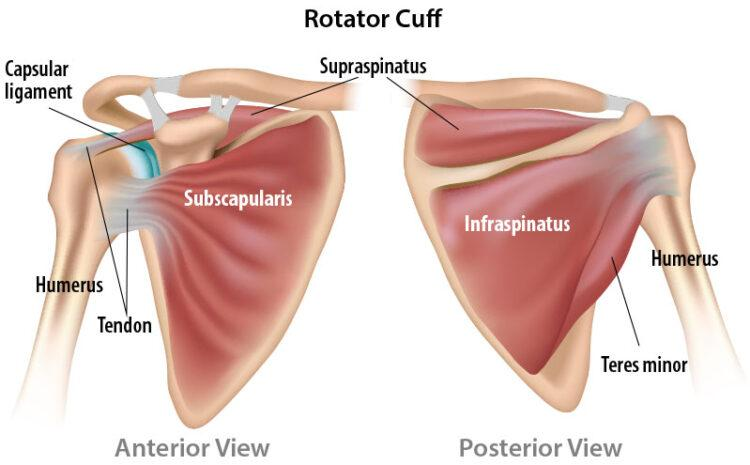
The rotator cuff consists of four muscles and their tendons that work together to stabilise and control movement of the shoulder joint.
Why Tennis Players Commonly Injure the Rotator Cuff
Tennis places enormous demands on the shoulder.
During activities such as:
Serving
Smashing
Forehand acceleration
High-speed overhead shots
Sudden deceleration after impact
the shoulder experiences repeated high forces at high speeds.
The rotator cuff must work continuously to keep the shoulder joint stable while these movements occur.
Over time, fatigue develops. If the larger muscles begin to dominate movement and the rotator cuff cannot keep up with the demands being placed on it, irritation and overload can occur.
This is why shoulder pain is particularly common in:
Tennis players
Swimmers
CrossFit athletes
Throwing athletes
Racquet sport players
Regular gym-goers
Is It Only a Sports Injury
Absolutely not.
Many rotator cuff injuries occur in people who have never played sport competitively.
At Rise NW10 Physiotherapy, we commonly see rotator cuff pain caused by:
Repetitive lifting
DIY projects
Decorating and painting
Manual labour
Sudden pulling movements
Falls onto the arm
Age-related tendon changes
Poor shoulder conditioning
Even simple daily activities can become painful when the shoulder loses stability and control.
Common Symptoms of a Rotator Cuff Injury
Rotator cuff injuries often develop gradually, although some occur suddenly following trauma.
Common symptoms include:
Pain lifting the arm overhead
Pain reaching behind your back
Pain taking your shirt off
Pain putting on a coat or jacket
Pain opening heavy doors
Weakness in the arm
A feeling of heaviness when lifting
Pain during sport
Pain at night, particularly when lying on the affected side
Many people also experience:
Clicking
Catching
Shoulder stiffness
Reduced range of motion
If these symptoms persist, it is worth seeking professional assessment before they worsen.
Why Standard Shoulder Exercises Often Don't Help
One of the biggest mistakes people make is focusing only on strengthening the larger "show muscles" around the shoulder, including:
Deltoids
Pectoral muscles
Upper trapezius
Latissimus dorsi
While these muscles are important, they cannot replace the stabilising role of the rotator cuff.
This often leads people to continue exercising through pain, stretching aggressively, or performing generic shoulder exercises they found online without addressing the underlying issue.
The result?
The shoulder becomes stronger in some areas but remains unstable and painful.
Successful rehabilitation usually requires:
Rotator cuff-specific strengthening
Load management
Movement retraining
Mobility restoration
Progressive return to activity
Why the Right Exercise at the Right Time Matters
One of the most important principles in shoulder rehabilitation is understanding that not all exercises are appropriate at every stage of recovery.
Many people assume that if strengthening is good, then more strengthening must be better.
Unfortunately, this is often what delays recovery.
Early-Stage Injury
If you have recently injured your shoulder and it is painful throughout the day, painful at night, or easily aggravated by simple movements, loading it heavily can actually make symptoms worse.
At this stage, the focus is often on:
Reducing pain and irritation
Maintaining movement
Restoring confidence in using the arm
Gradually reintroducing load
Starting heavy strengthening too early can overload an already irritated tendon and slow recovery.
Mid-Stage Rehabilitation
As pain settles, rehabilitation progresses towards:
Improving rotator cuff strength
Restoring shoulder control
Increasing tolerance to everyday activities
Improving movement quality
This is where structured strengthening becomes increasingly important.
Late-Stage Rehabilitation and Return to Sport
This is where many rehabilitation programmes fall short.
For example, imagine a tennis player preparing to return to serving.
If they are only performing light resistance band exercises, their shoulder may not be exposed to anything close to the forces experienced during a tennis serve.
A tennis serve generates significantly greater loads than a resistance band exercise.
While band exercises may be appropriate during the earlier stages of rehabilitation, they are often insufficient preparation for high-level sporting demands.
Late-stage rehabilitation should progressively expose the shoulder to:
Higher loads
Faster movements
Sport-specific positions
Power development
Endurance training
The goal is not simply to make the shoulder stronger.
The goal is to make it strong enough for the specific demands of the individual.
For one person, that may mean lifting a child without pain.
For another, it may mean serving at full speed on a tennis court.
This is why personalised rehabilitation is so important. The right exercise at the wrong time can be ineffective, while the right exercise at the right stage can dramatically accelerate recovery.
Why Early Treatment Matters
Many people hope shoulder pain will simply settle on its own.
Sometimes it does.
However, persistent rotator cuff problems often become more difficult to treat the longer they are ignored.
Over time:
Tendons become more sensitive
Flare-ups become more frequent
The shoulder loses mobility
Stiffness develops
Other joints begin compensating
We often see patients whose original tendon problem has become complicated by stiffness, weakness, and movement restrictions.
At that stage, rehabilitation usually takes longer because we are addressing multiple problems instead of one.
Early treatment can prevent this progression and often leads to faster recovery.
How Can Physiotherapy Help Rotator Cuff Injuries
The good news is that most rotator cuff injuries respond extremely well to physiotherapy.
Many people can return to work, sport, gym training, and everyday activities without surgery when they follow an appropriate rehabilitation programme.
At Rise NW10 Physiotherapy, we assess:
Shoulder strength
Rotator cuff function
Movement control
Joint mobility
Training habits
Work demands
Compensation patterns
Using this information, we create a personalised rehabilitation plan designed to:
Reduce pain
Restore movement
Improve shoulder stability
Rebuild strength
Improve confidence
Prevent future flare-ups
Every rehabilitation programme is tailored to the individual's goals and the stage of their recovery.
Final Thoughts
The rotator cuff plays a vital role in keeping the shoulder stable, strong, and pain-free.
Whether you are a tennis player struggling with serves, a gym-goer training through discomfort, a tradesperson working overhead, or someone simply finding it painful to put on a coat, shoulder pain should not be ignored.
The earlier the problem is identified and treated, the easier it is to restore strength, movement, and confidence.
If shoulder pain has been lingering for weeks or months, getting it assessed early can help prevent long-term stiffness and a much longer recovery process.
Need help with shoulder pain or a rotator cuff injury? Contact Rise NW10 Physiotherapy to book a comprehensive shoulder assessment and start your recovery with a personalised treatment plan.


Comments